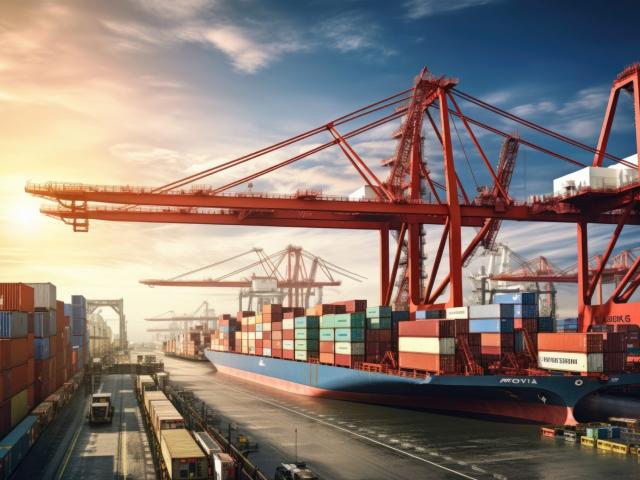
China's Ports: Gateways to the World
China has the world's busiest port cluster, with seven of the top ten global container ports located here. Understanding the characteristics, advantages, and suitable scenarios of each port is crucial for export companies looking to optimize their logistics plans. This guide provides a comprehensive analysis of China's major international ports.
1. Port of Shanghai
The world's largest container port, with an annual throughput exceeding 47 million TEUs. It consists of the Yangshan Deep-Water Port and Waigaoqiao Port areas. Advantages: shipping routes covering 296 ports worldwide; highest sailing frequency; high customs clearance efficiency; comprehensive supporting services. Suitable for the import and export needs of enterprises in East China (Shanghai, Jiangsu, Zhejiang).
2. Port of Ningbo-Zhoushan
The third-largest port globally, with a throughput exceeding 35 million TEUs in 2024. A deep-water port capable of handling the world's largest container ships. Mainly handles heavy export cargo, with rates generally slightly lower than those of the Port of Shanghai. Suitable for enterprises in Zhejiang and surrounding areas.
3. Port of Shenzhen
The fourth-largest port globally, comprising three major port areas: Yantian, Shekou, and Chiwan. It is the most important foreign trade port in South China. Yantian Port Area mainly serves European and American routes, while Shekou Port Area focuses on Asian short-sea routes. Suitable for enterprises on the east bank of the Pearl River Delta (Shenzhen, Dongguan, Huizhou).
4. Port of Guangzhou
A comprehensive hub port in Southern China, including Nansha Port Area and Xinsha Port Area. It caters to both domestic and foreign trade, with the Nansha Port Area developing rapidly in recent years and its shipping network continuously expanding. Suitable for enterprises on the west bank of the Pearl River Delta (Guangzhou, Foshan, Zhongshan).
5. Port of Qingdao
The largest port in Shandong Province and an important transit hub in East Asia. It offers密集 routes to Japan and South Korea and boasts world-leading refrigerated container handling capabilities. Suitable for enterprises in Shandong and North China regions, especially for trade with Japan and South Korea.
6. Port of Tianjin
The largest port in North China and Beijing's maritime gateway. It is the most convenient seaport for the Beijing-Tianjin-Hebei region. It has an advantage in land-bridge combined transport with Mongolia and regions in Central Asia.
7. Port of Xiamen
An important port on the southeastern coast and a hub for trade with Taiwan. Its shipping routes cover major ports in Southeast Asia, Europe, and the United States.
8. Port of Dalian
The largest port in Northeast China and a shipping center in Northeast Asia. It serves as the main sea outlet connecting the three northeastern provinces and eastern Inner Mongolia.
9. How to Choose the Right Port
When selecting a port, factors to consider comprehensively include: the geographical location of the factory (land transport distance and cost), route coverage (availability of direct routes), port rates (such as THC), customs clearance efficiency, sailing frequency, and shipping line service levels. It is recommended to choose a nearby port to reduce land transport costs, but the advantage of a farther port on specific routes should also not be ruled out.
10. Summary
The comprehensive strength of China's port cluster is globally leading, providing abundant choices for import and export enterprises. Bofeng Logistics has a service network in all major ports in China and can offer you the optimal port selection and logistics plan.
Related Bofeng Logistics Services
Need logistics services? Contact us for professional solutions and quotes:
Related Logistics Services
Bofeng Logistics offers the following related services, feel free to inquire: