
Lianyungang Shi
Jiangsu Sheng
China
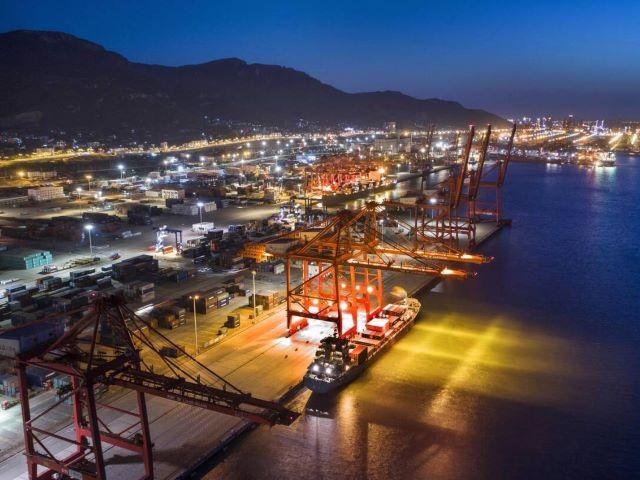
Lianyungang Port, located on the coast of Jiangsu in central China's coastal area, on the shores of the Yellow Sea, is the largest seaport in Jiangsu Province and one of China's major coastal ports. It is backed by the Shandong Peninsula to the north, connects with the Yangtze River Delta Economic Circle to the south, and links to the vast central and western hinterlands to the west, boasting a unique geographical position. As the eastern bridgehead of the New Eurasian Land Bridge, Lianyungang Port serves as a crucial node connecting the Pacific and Atlantic Oceans and linking trade between East and West, and is one of the most convenient and economical sea passageways for the central and western regions. Relying on the Lanzhou-Lianyungang and Xinjiang-Lanzhou railway arteries, its radiation range covers more than ten provinces of China, undertaking the important mission of importing and exporting bulk goods for inland areas, and is hailed as "the gateway for China's central and western regions to go global."
Lianyungang Port boasts large-scale, fully functional dock facilities, having formed a development pattern of "one port with four zones" centered around the Lianyungang zone, Ganyu zone, Xuwei zone, and Guanhe zone. The port has over 80 production berths, among which over 60 are deep-water berths of 10,000-ton-class or above, capable of handling 300,000 DWT bulk carriers and 200,000 DWT container vessels. The port area is equipped with advanced loading and unloading machinery, including efficient quay cranes, gantry cranes, and ship unloaders. Its annual cargo handling capacity exceeds 100 million tons for bulk cargo, and its annual container throughput exceeds 5 million TEUs. The port's rear areas are equipped with comprehensive warehousing, storage yards, bonded logistics parks, and dedicated railway lines, enabling seamless sea-rail intermodal transport. Additionally, Lianyungang Port has modern infrastructure, including deep-water channels, breakwaters, and navigation aids, which meet the requirements for safe, all-weather vessel access and departure.
Leveraging its core geographical advantages, Lianyungang Port has established a shipping route network covering all major global trading regions. Currently, the port operates more than 80 container shipping routes for both international and domestic trade. Among them, foreign trade routes directly serve Southeast Asia, the Middle East, Africa, Europe, and the Americas, establishing trade links with ports in about 150 countries and regions worldwide. Domestic trade routes cover all major coastal ports in China, directly connecting from ports like Yingkou and Qinhuangdao in the north to Guangzhou and Shenzhen in the south. Notably, as the starting point of the New Eurasian Land Bridge, Lianyungang Port connects via international trains to the five Central Asian countries, Russia, Mongolia, and various European countries, forming a unified three-dimensional transportation system of "sea-rail intermodal, land-sea coordination." Especially for export goods from the central and western regions, such as mineral products, grain, chemicals, and machinery equipment, Lianyungang Port offers shorter inland transportation distances compared to neighboring ports, significantly reducing logistics costs.
The core advantages of Lianyungang Port lie in its unique strategic position and multimodal transport capabilities. First, the port is located in the central part of the Jiangsu coast, benefiting from the economic influence of the Yangtze River Delta economic belt while being adjacent to the Beijing-Tianjin-Hebei urban agglomeration, providing strong regional economic support. Second, as the eastern bridgehead of the New Eurasian Land Bridge, Lianyungang Port has an extremely convenient railway collection and distribution system. The Lanzhou-Lianyungang and the Xinjiang-Lanzhou railways directly connect to Central Asia and Europe, allowing goods departing from the port to travel westward all the way to Rotterdam, saving about half the time compared to maritime transportation via the Suez Canal. Third, the port serves as a national-level sea passageway for the central and western regions, providing the closest coastal outlet to inland provinces such as Henan, Shaanxi, Gansu, and Xinjiang, significantly shortening the inland transportation distance for imported and exported goods. Furthermore, Lianyungang Port emphasizes smart port and green port development, implements facilitation measures such as e-ports and paperless customs clearance, with clearance efficiency ranking among the top ports nationwide. The port also enjoys policy advantages such as national-level bonded logistics centers and comprehensive bonded zones, offering enterprises integrated services like warehousing, processing, and entrepôt trade.
In summary, Lianyungang Port, by virtue of its superior geographical location, extensive port scale, dense route network, and outstanding multimodal transport advantages, has become an important comprehensive hub port on China's coast, playing an irreplaceable role in serving the coastal development of Jiangsu, supporting the construction of the New Eurasian Land Bridge economic corridor, and promoting the opening-up of the central and western regions.
Bofeng Logistics specializes in providing domestic and international shipping container transportation services departing from Lianyungang Port, with a transportation network covering major ports nationwide, offering stable transit times and competitive prices. Customers are welcome to call for consultation or inquire online. We will tailor efficient and economical logistics solutions for you.