
Shanghai Shi
China
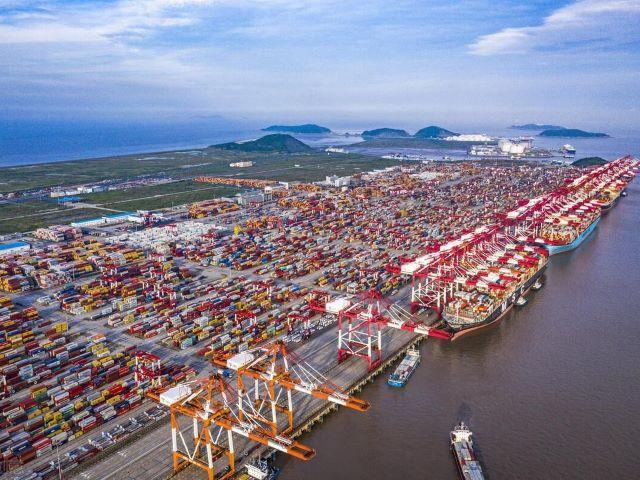
Shanghai Port is located on the eastern coast of China, at the mouth of the Yangtze River, bordering the East China Sea. It serves as a key gateway connecting China's inland regions to global maritime trade. As one of the world's largest container ports, Shanghai Port has become an indispensable core hub in the international shipping network thanks to its unique geographical advantage.
In terms of scale, Shanghai Port has maintained an annual container throughput of over 47 million TEUs for many consecutive years, ranking first globally. The port mainly consists of the Waigaoqiao Port Area, the Yangshan Deep-Water Port Area, and the Wusongkou Port Area. Among them, the Yangshan Deep-Water Port Area is connected to the mainland by the Donghai Bridge and boasts exceptional deep-water conditions, capable of accommodating the world's largest container ships. The Waigaoqiao Port Area handles a large volume of import and export cargo transshipment from the Yangtze River Delta and the Yangtze River basin. The entire port is equipped with advanced automated terminal facilities, significantly improving handling efficiency and reducing vessel turnaround time.
Shanghai Port's shipping network covers major global economic regions, including key routes to Europe, North America, Southeast Asia, the Middle East, Africa, and South America. With dense, high-frequency liner services calling almost every week, Shanghai Port has become one of the preferred ports of call for international liner companies. Whether on the Asia-Europe route to Rotterdam or the Pacific route to Los Angeles, Shanghai Port offers high-frequency and highly reliable transport services. This network density allows goods to quickly connect with global markets, providing logistics companies with great flexibility.
The port's advantages are mainly reflected in four aspects: first, the natural deep-water conditions of the Yangshan Deep-Water Port Area, which can receive ultra-large container ships with a draft of over 15 meters around the clock without waiting for tides; second, the widespread application of automated terminal technology—such as the fully unmanned operation at the Yangshan Phase IV automated terminal, which reduces human error and improves safety; third, the Shanghai Pilot Free Trade Zone policies, which offer import and export enterprises tariff reductions, customs clearance facilitation, financial innovation, and other incentives, effectively lowering logistics costs; and fourth, the river-sea intermodal transport advantage. Through the Yangtze River Golden Waterway, Shanghai Port can directly transship goods from inland cities such as Chongqing, Wuhan, and Nanjing to oceangoing vessels, creating seamless integration between domestic and foreign trade.
Within China's domestic container shipping system, Shanghai Port is not only the main channel for foreign trade but also an important hub for domestic coastal transport. Through north-south routes, Shanghai Port connects northern ports such as Qingdao, Tianjin, and Dalian, as well as southern ports like Xiamen, Shenzhen, and Guangzhou. Domestic containers are collected, distributed, and transshipped here, forming a dense network covering the entire country's coastline. At the same time, Shanghai Port is a core node for Yangtze River feeder services, with a large volume of domestic cargo from cities along the Yangtze River being transshipped through Shanghai Port to other coastal ports or even exported overseas via "water-water transshipment."
The continuous development of Shanghai Port relies on efficient logistics support services. Bofeng Logistics specializes in providing domestic and international container shipping services departing from Shanghai Port, covering major ports across the country. Please call for consultation to obtain a customized logistics solution.