Tianjin Shi
China
Tianjin Port is located at the mouth of the Haihe River on the western shore of Bohai Bay, at the intersection of the Beijing-Tianjin-Hebei urban agglomeration and the Bohai Rim Economic Circle. It is the largest comprehensive port in northern China and a significant foreign trade hub. Backed by the vast hinterlands of North and Northwest China, and relying on Tianjin as the northern economic center, it radiates to Northeast Asia and connects to major global economies. As a key node of the "Belt and Road" Initiative, Tianjin Port is not only the maritime gateway for the Beijing-Tianjin-Hebei region but also the only port in northern China with three transcontinental railway corridors via the Eurasia Land Bridge, giving it an exceptionally prominent strategic position.
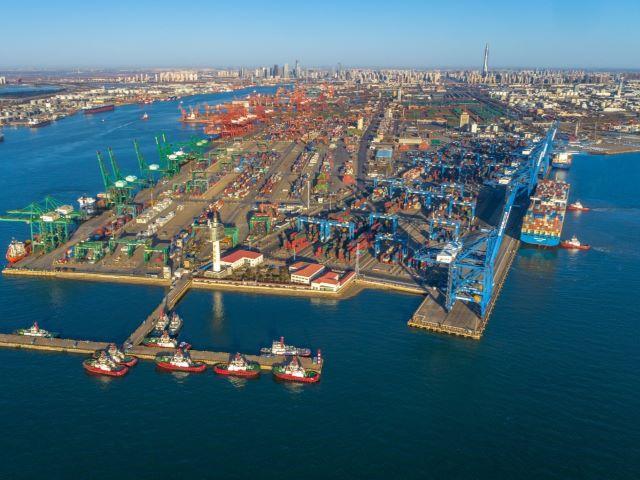
Tianjin Port is an artificially excavated deep-water port with a vast area, mainly composed of the North Harbor, South Harbor, and East Harbor areas. The North Harbor area primarily handles containers, general cargo, and roll-on/roll-off transport; the South Harbor area concentrates on bulk cargo operations such as coal, ore, and crude oil; and the East Harbor area is the emerging core container operations zone and the central area of the Free Trade Pilot Zone. The port has over 200 operational berths, including more than 130 berths of 10,000-ton class or above, capable of accommodating the world's largest container vessels and 400,000-ton ore carriers. The water depth of the port channels is maintained at over -15 meters year-round, allowing for the all-weather passage of 200,000-ton vessels. Additionally, Tianjin Port is equipped with advanced automated loading and unloading equipment, intelligent yard management systems, and an efficient collection and distribution system. Its container throughput consistently ranks among the top in the country and is within the top ten globally. The port area also includes special supervision zones such as the Comprehensive Bonded Zone and the Dongjiang Bonded Port Area, providing convenient bonded logistics and processing services for international trade.
Tianjin Port's shipping network covers all major global trading regions. It has over 130 container liner routes, covering more than 800 ports in over 200 countries and regions including Southeast Asia, the Middle East, Africa, Europe, the Americas, and Oceania. Among these, the European routes, Mediterranean routes, North American West Coast routes, and Southeast Asian routes are the densest, with high voyage frequency and fast turnaround efficiency. At the same time, Tianjin Port is the primary gateway from northern China to Japan and South Korea, with frequent direct routes to ports such as Incheon and Busan in South Korea, and Tokyo and Yokohama in Japan. In addition to ocean shipping trunk lines, Tianjin Port also operates multiple domestic trade routes connecting with major coastal ports across China. Through an extensive railway, highway, and inland waterway transport network, goods from Shanxi, Inner Mongolia, Shaanxi, Hebei, and other regions can be conveniently shipped out via Tianjin Port, forming a multi-modal transport system integrating "sea-rail" and "sea-truck" intermodal services. With the advancement of the "China-Mongolia-Russia Economic Corridor" and the "China-Singapore (Chongqing) Strategic Connectivity Demonstration Project," Tianjin Port, as one of the eastern starting points of the Eurasia Land Bridge, also undertakes the task of connecting China's inland regions with Central Asia and Europe via land bridge transport.
The core advantage of Tianjin Port lies in the scale and supporting capacity of the largest artificial deep-water port in the north. First, its excellent deep-water conditions can receive large vessels around the clock without waiting for tides, reducing the risk of schedule delays. Second, the port area has comprehensive supporting facilities, offering one-stop services such as bonded warehousing, processing, distribution, finance, and insurance, significantly reducing corporate logistics costs. Third, its level of informatization and intelligence is leading, with a high degree of automation in container terminals and electronic customs inspection procedures, placing customs clearance efficiency among the top in the country. Furthermore, Tianjin Port is adjacent to the Tianjin Pilot Free Trade Zone, enjoying policy benefits such as customs supervision innovation, tax incentives, and foreign exchange facilitation, making it particularly suitable for international trade, cross-border e-commerce, and international transshipment. Finally, Tianjin Port's collection and distribution system is extremely powerful, with high-speed rail lines such as Beijing-Shanghai, Tianjin-Qinhuangdao, and Tianjin-Baoding, along with the expressway network, closely connecting the port with the inland hinterland. Railways extend directly into the port area, truly enabling "door-to-door" rapid transport.
As a core pillar of the coordinated development of the Beijing-Tianjin-Hebei region and an important starting point of the "Silk Road Economic Belt," Tianjin Port plays an irreplaceable role in serving national strategies. It is not only the maritime gateway for the Beijing-Tianjin-Hebei region, handling approximately 70% of the region's import and export cargo throughput, but also a critical node for China's participation in the global supply chain and industrial chain division of labor. With the continuous deepening of "Belt and Road" cooperation, Tianjin Port actively expands routes to emerging markets such as Southeast Asia, the Middle East, and Africa, promoting its transformation into a trade port, hub port, and smart port. Concurrently, Tianjin Port is also at the forefront of green environmental protection, vigorously promoting shore power facilities, new energy collection trucks, and ecological port area construction, dedicated to achieving sustainable development.
Bofeng Logistics specializes in providing domestic and international sea freight container transport services from Tianjin Port, covering major coastal and inland river ports across the country, with ample shipping capacity, stable transit times, and transparent pricing. Customers are welcome to call or inquire online; we will tailor the optimal transport solution based on the characteristics of your goods.